Concept: Association
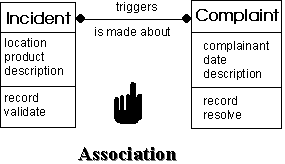 An association
describes a relationship between two classes of object that must
be remembered by a system. For example, in a complaint management
system an incident triggers a complaint. The system must remember
which complaints were triggered by which incidents. Associations
can also encapsulate the basic business rules of an organisation.
For example an insurance claim must be associated with an insured
person.
An association
describes a relationship between two classes of object that must
be remembered by a system. For example, in a complaint management
system an incident triggers a complaint. The system must remember
which complaints were triggered by which incidents. Associations
can also encapsulate the basic business rules of an organisation.
For example an insurance claim must be associated with an insured
person.
The vast majority of associations involve two classes (binary)
but on occasion can involve three (ternary) or more. Where
possible all associations should be decomposed into binaries as
ternaries and above are difficult to conceptualize.

In a binary association is fully described by indicating:
- Each class' relationship with the other
- Its cardinality and
- Its optionality.
In the complaint management example the association between
incident and complaint is fully described by:
- an incident triggers a complaint
- a complaint is made about
an incident
Note that the association names are read from the model in a
clockwise direction.
Cardinality
Cardinality is expressed in terms of:
- one to one
- one to many
- many to many
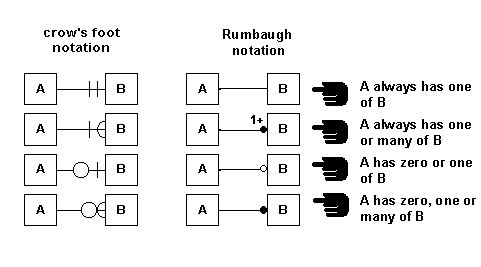
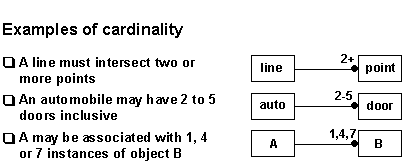 Optionality is
expressed in terms of:
Optionality is
expressed in terms of:
- Must have. For example, a purchase order must have a line
item. In other words, it is mandatory.
- May have. For example, a purchase order may have a
requisition number. In other words, it is optional.
Two classes may have more than one relationship. For example:
| relationship 1 |
a doctor treats a patient
a patient is treated by
a doctor |
| relationship 2 |
a doctor invoices a patient
a patient is invoiced by
a doctor |
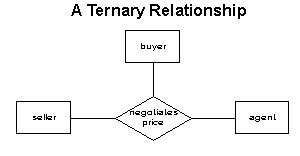 A ternary association
describes a fact that involves three classes and cannot be split
up into component binary associations without losing information.
For example, when a seller negotiates a price with a buyer
through an agent, a decomposition of the ternary into two binary
associations between buyer and seller and seller and
agent would lose the information on which buyer was involved
in the deal between the seller and agent.
A ternary association
describes a fact that involves three classes and cannot be split
up into component binary associations without losing information.
For example, when a seller negotiates a price with a buyer
through an agent, a decomposition of the ternary into two binary
associations between buyer and seller and seller and
agent would lose the information on which buyer was involved
in the deal between the seller and agent.
A ternary association is described in terms of the role that
each class plays in the association. For example:
- An agent negotiates a price
between a buyer and a seller
- A buyer negotiates a price
with a seller through an agent
- A seller negotiates a price
with a buyer through an agent
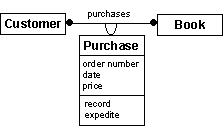 Associative classes are used
when it is useful to keep information about the association
itself. For example when a customer purchases a book, information
on the actual purchase does not belong with the customer or the
book, it is a class in itself. We therefore create the class purchase.
Associative classes are used
when it is useful to keep information about the association
itself. For example when a customer purchases a book, information
on the actual purchase does not belong with the customer or the
book, it is a class in itself. We therefore create the class purchase.
Associative classes are common in many to many associations.
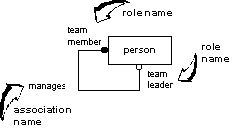 Role names
describe the role played in an association by a class. Using role
names adds clarity to the model. For example, when a person
manages other persons in a team it is useful to indicate the two
roles played in the association by the same class. In the case of
a team leader/team member association a person
who plays the role of team leader manages zero, one or many persons
who play the role of team member.
Role names
describe the role played in an association by a class. Using role
names adds clarity to the model. For example, when a person
manages other persons in a team it is useful to indicate the two
roles played in the association by the same class. In the case of
a team leader/team member association a person
who plays the role of team leader manages zero, one or many persons
who play the role of team member.
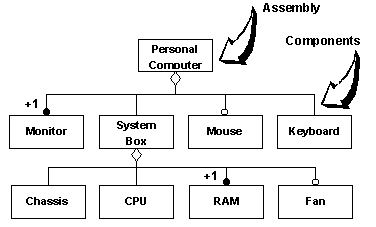
Aggregates provide a shorthand method of modeling associations
between objects when they are the components of an assembly.
 Recursive
Aggregates
Recursive
Aggregates
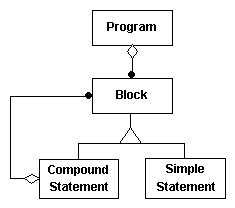
A recursive aggregate contains an instance of the same kind of
aggregate. For example, a computer program is an aggregation of
blocks with optionally recursive compound statements; the
recursion terminates with simple statements. Blocks can be nested
to arbitrary depth.
Software Engineering Web -
Copyright ã 1997 Chambers & Associates Pty Ltd
Module: 104 v1.0 c_assocn.htm
Updated: July 02, 2006