| 1 |
Review the concept of
associations. |
| 2 |
Identify verb
phrases in problem statements, requirement
statements, business rules and concepts of
operation. For example:
- a customer purchases
a book (class=customer,
book; association=purchases)
- a customer complains
about a product(class=customer,
product ; association=complains about)
|
| 3 |
Eliminate irrelevant
associations that are:
a) Outside the problem domain
b) Specify implementation approaches (e.g. the
transaction takes a record lock) |
| 4 |
Discard actions. Associations
describe class structure not transient events. For
example "accountant creates a credit note"
describes an action on a credit note it does not imply an
association between accountant and credit note that needs
to be recorded. |
| 5 |
Omit derived associations.
Omit associations that can be defined in terms of other
associations. For example, given the business rule,
"a credit note is issued on an invoice for validated
customer complaints", an association need not be
defined between complaint and invoice.
It is redundant as it can be derived by identifying the credit
note the complaint
was associated with and accessing the related invoice
from the is issued on association. 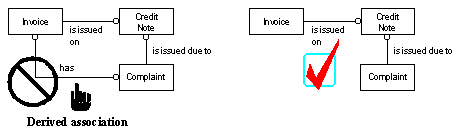
|
| 6 |
Identify associative classes. |
| 7 |
Define the cardinality
of the association. 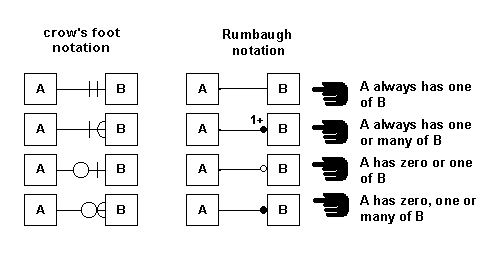
|